As early as the 9th century, the great weakness of monoalphabetic ciphers (Caesar cipher) was recognized in the Islamic world. The distribution of letters follows a specific but constant pattern in every language. As explained in the last section, the letter ‘e’ is by far the most common letter in the English language.
To demonstrate that this applies to any given (longer) texts, the text of the Book of Revelations from the King James Bible was analyzed. The resulting distribution of letters was plotted against the distribution from the table. The result is shown in the figure below.
Code
import stringimport pandas as pdimport matplotlib.pyplot as pltimport numpy as npdef file_reader(path : str) ->str:withopen(path, mode='r', encoding='utf-8') as f: text = f.read()return textdef text_cleaning(text : str) ->str: clean = text.upper() \ .replace('Ä', 'AE') \ .replace('Ö', 'OE') \ .replace('Ü', 'UE') \ .replace('ß', 'SS') \ .replace(' ', '') \ cleaned_text =''for c in clean:if c.isalpha(): cleaned_text += creturn cleaned_textdef file_writer(path : str, text : str) ->None: i =0 grouped_text =""for c in text: i +=1if i %50==0: grouped_text += c +"\n"elif i %5==0: grouped_text += c +" "else: grouped_text += cwithopen(path, mode='w', encoding='utf-8') as f: f.write(grouped_text)revelation = file_reader('revelation.txt')cleaned_revelation = text_cleaning(revelation)file_writer('cleaned_revelation.txt', cleaned_revelation)def letter_frequency(text: str) ->dict: frequency = {} total_letters =0for char in text:if char notin frequency: frequency[char] =1else: frequency[char] +=1 total_letters +=1for key, value in frequency.items(): frequency[key] = (value / total_letters) *100return frequencyfrequency_revelation = letter_frequency(cleaned_revelation)standard_frequency = {'E': 12.02,'T': 9.10,'A': 8.12,'O': 7.68,'I': 7.31,'N': 6.95,'S': 6.28,'R': 6.02,'H': 5.92,'D': 4.32,'L': 4.03,'C': 2.78,'U': 2.76,'M': 2.41,'W': 2.36,'F': 2.23,'G': 2.02,'Y': 1.97,'P': 1.93,'B': 1.49,'V': 0.98,'K': 0.77,'J': 0.15,'X': 0.15,'Q': 0.10,'Z': 0.07}df = pd.DataFrame.from_dict([standard_frequency, frequency_revelation])df.index = ['Standard Frequency', 'Revelation Frequency']dft = df.Tdft = dft.sort_index()dft['Standard Frequency'] = dft['Standard Frequency'].astype(float)dft['Revelation Frequency'] = dft['Revelation Frequency'].astype(float)# --- Erstellen Sie das Side-by-Side-Balkendiagramm ---# Legen Sie die Breite der Balken festbar_width =0.35# Verwenden Sie den Index des transponierten DataFrames (dft)x = np.arange(len(dft.index))fig, ax = plt.subplots(figsize=(12, 7))# Zeichnen Sie die Balken für die beiden Spalten aus dftax.bar(x - bar_width/2, dft['Standard Frequency'], bar_width, label='Standard Frequency')ax.bar(x + bar_width/2, dft['Revelation Frequency'], bar_width, label='Revelation Frequency')ax.set_xticks(x)ax.set_xticklabels(dft.index)ax.set_xlabel('Letters')ax.set_ylabel('Frequency (%)')ax.set_title('Comparison of Letter Frequencies')ax.legend()plt.tight_layout()plt.show()
<Figure size 3600x2100 with 1 Axes>
The graphic shows that for a text length of 57,891 letters, the distribution in a literary text is almost identical to the general frequency distribution in the English language.
The following graphic shows what happens to the distribution of letters when the same text is encrypted with a Caesar cipher.
Code
def caesar(text : str, shift : int, encrypt=True) ->str: text = text.upper() result =""if encrypt:for char in text: shifted = (ord(char) -ord('A') + shift) %26+ord('A') result +=chr(shifted)else:for char in text: shifted = (ord(char) -ord('A') - shift) %26+ord('A') result +=chr(shifted)return resultciphered_revelation = caesar(cleaned_revelation, 6, encrypt=True)frequency_enyrpyted_revelation = letter_frequency(ciphered_revelation)dft['Revelation Frequency Encrypted'] = pd.Series(frequency_enyrpyted_revelation)# --- Erstellen Sie das Side-by-Side-Balkendiagramm ---# Legen Sie die Breite der Balken festbar_width =0.35# Verwenden Sie den Index des transponierten DataFrames (dft)x = np.arange(len(dft.index))fig, ax = plt.subplots(figsize=(12, 7))# Zeichnen Sie die Balken für die beiden Spalten aus dftax.bar(x - bar_width/2, dft['Standard Frequency'], bar_width, label='Standard Frequency')ax.bar(x + bar_width/2, dft['Revelation Frequency Encrypted'], bar_width, label='Revelation Frequency Encrypted')ax.set_xticks(x)ax.set_xticklabels(dft.index)ax.set_xlabel('Letters')ax.set_ylabel('Frequency (%)')ax.set_title('Comparison of Letter Frequencies of the Encrypted Text')ax.legend()plt.tight_layout()plt.show()
<Figure size 3600x2100 with 1 Axes>
It is clearly visible that the distribution follows the same pattern - shifted by six positions. This analysis allows the decryption of the text without having to try all possible key alphabets.
Vigenère Chiffre
The Vigenère Cipher is a polyalphabetic cipher. The method is named after Blaise de Vigenère (1523 - 1596). Polyalphabetic means that not one shift is used for encryption, but - changing after each letter - several shifts are used.
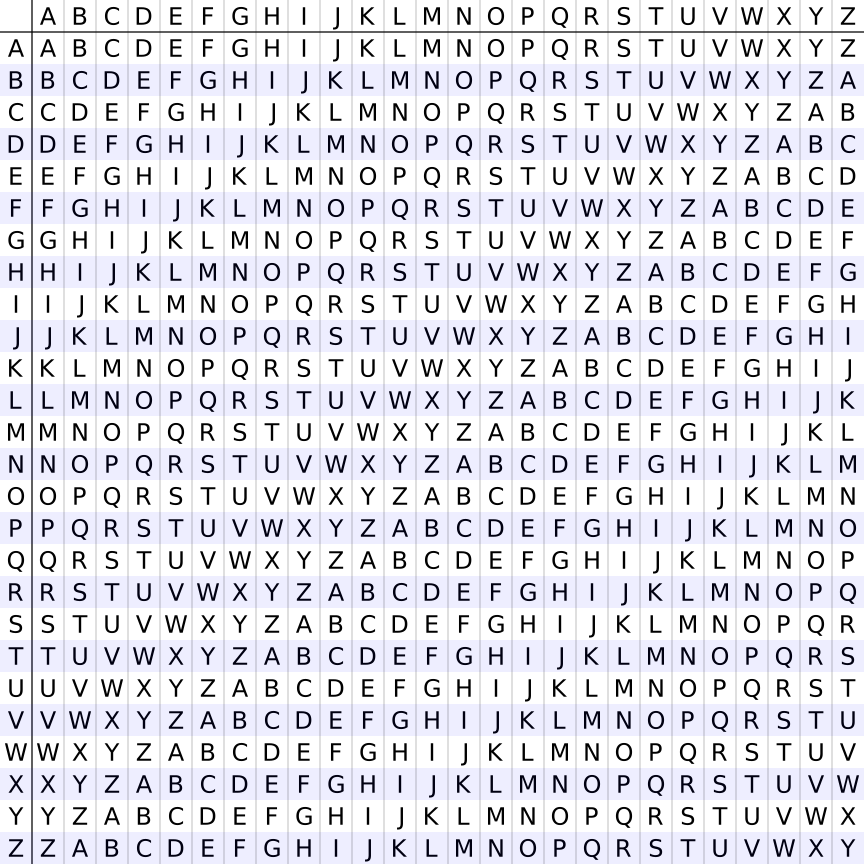
To achieve this, a so-called Vigenère square is used as shown below.
To encrypt a plaintext, the Vigenère method requires a keyword. The keyword should be as long as possible. The following example is intended to show how the Vigenère method works. The plaintext to be encrypted is ‘Cryptology is amazing’ and the key is ‘Buelrain’.
As an aid, text and key are presented in a table.
cryptologyisamazing
buelrainbuelrainbue
The key is repeated without spaces until the letter sequence of the key is as long as the letter sequence to be encrypted.
Next the letter to be encrypted is searched in the header of the Vigenère square. This identifies the column with the shifted alphabet. The encrypted letter is obtained by searching in the column with the row headers the letter of the key located under the letter to be encrypted. The intersection of the row with the previously found column corresponds to the encrypted letter.
On a computer, the Vigenère cipher can be implemented by using modular arithmetic. To do this, each letter is assigned a numerical value according to the pattern \(a = 0, b = 1, ... , z = 25\). The encryption is then performed according to the ‘formula’ \(C_i = (P_i + K_i)\ mod\ 26\) where the letters \(C\) stand for the ciphertext, \(P\) for the plaintext and \(K\) for the key. The index \(_i\) stands for the \(i\)-th letter in the text sequence.
The example above can be illustrated as follows.
 c  r  y  p  t  o  l  o  g  i  e  s  a  m  a  z  i  n  g
02 17 24 15 19 14 11 14 06 08 04 18 00 12 00 25 08 13 06
 b  u  e  l  r  a  i  n  b  u  e  l  r  a  i  n  b  u  e
01 20 04 11 17 00 08 13 01 20 04 11 17 00 08 13 01 20 04

03 37 28 26 36 14 19 27 07 28 08 29 17 12 08 38 09 33 10

03 11 02 00 10 14 19 01 07 02 08 19 09 19 00 02 01 07 17
 D  L  C  A  K  O  T  B  H  C  I  T  J  T  A  C  B  H  R
For decryption, the same formula can be used, but with a minus instead of a plus (\(P_i = (C_i - K_i + 26)\ mod\ 26\)). The addition of 26 in the brackets is used to avoid negative numbers.
How the Vigenère cipher affects the distribution of letters can be seen in the graphic below.
Code
def vigenere_chiffre(text: str, key: str, encrypt=True) ->str:""" Implementiert die Vigenère-Verschlüsselung für einen gegebenen Klartext und Schlüssel. Args: klartext (str): Der zu verschlüsselnde Text schluessel (str): Das Schlüsselwort für die Verschlüsselung Returns: str: Der verschlüsselte Text """# initialisiere den resultierenden Text resulting_text =''# bestimme die Schlüssellänge für die anschliessende Modulo-Operation key_length =len(key)# itererie über den Eingabetext unter gleichzeitiger Erfassung des Indexfor i, char inenumerate(text):# berechne den Zahlwert des Buchstabens aus der ascii Tabelle char_no =ord(char) -97 key_no =ord(key[i % key_length]) -97if encrypt ==True:# berechne den Zahlwert des verschlüsselten Buchstabens ciph_no = (char_no + key_no) %26else:# berechne den Zahlwert des entschlüsselten Buchstabens ciph_no = (char_no + (26- key_no)) %26# übernehme das Zeichen aufgrund seines Zahlwertes aus der ascii Tabelle ciph =chr(ciph_no +97)# füge den Buchstaben am resultierenden Text an resulting_text += ciphreturn resulting_textrevelation_vigenere = vigenere_chiffre(cleaned_revelation.lower(), 'buelrain', encrypt=True)revelation_vigenere_frequency = letter_frequency(revelation_vigenere.upper())dft['Revelation Frequency Vigenere'] = pd.Series(revelation_vigenere_frequency)# --- Erstellen Sie das Side-by-Side-Balkendiagramm ---# Legen Sie die Breite der Balken festbar_width =0.35# Verwenden Sie den Index des transponierten DataFrames (dft)x = np.arange(len(dft.index))fig, ax = plt.subplots(figsize=(12, 7))# Zeichnen Sie die Balken für die beiden Spalten aus dftax.bar(x - bar_width/2, dft['Standard Frequency'], bar_width, label='Standard Frequency')ax.bar(x + bar_width/2, dft['Revelation Frequency Vigenere'], bar_width, label='Revelation Frequency Vigenère')ax.set_xticks(x)ax.set_xticklabels(dft.index)ax.set_xlabel('Letters')ax.set_ylabel('Frequency (%)')ax.set_title('Comparison of Letter Frequencies of the Vigenère Encrypted Text')ax.legend()plt.tight_layout()plt.show()
<Figure size 3600x2100 with 1 Axes>
It is quite obvious that the distribution of letters in a polyalphabetically encrypted text is significantly different from that in normal text. The Vigenère cipher was therefore considered ‘la chiffre indéchiffrable’ for about 300 years.
However, a special case of the Vigenère cipher is actually not decipherable. This is the case when the key is longer than the plaintext. This is called the “One-Time Pad”.